Thursday, October 16, 2008
Two sides to every story
I read the origin website, and I still believe that there are aliens on other planets. Yes, scientists say that our Earth is a rare planet, and that a planet that can support life is improbable, but the universe is enormous. How do we know that there's not another solar system like ours, and that there's another planet like Earth? We don't. And if life can be found on Earth, how come it can't other places? There's no solid proof to prove me otherwise, so I believe that there are aliens on other planets.

Monday, October 13, 2008
Black Holes- a type of dark matter
a) what are the parts of a black hole?
- jets of gas, accretion disk, event horizon
b) how is gravity related to a black hole?
- it's gravity is so strong that that its escape velocity exceeds the speed of light
c) how can we see the holes if they are black?
- from its shadows, and by observing its effects on the stars and gas close to it
d) what's a Swarzschild radius?
- characteristic mass associated with every radius
e) how do Einstein's theories relate to this?
He theorized that the mass and radius of an object actually curves space-time which is why light becomes trapped in a black hole.
- jets of gas, accretion disk, event horizon
b) how is gravity related to a black hole?
- it's gravity is so strong that that its escape velocity exceeds the speed of light
c) how can we see the holes if they are black?
- from its shadows, and by observing its effects on the stars and gas close to it
d) what's a Swarzschild radius?
- characteristic mass associated with every radius
e) how do Einstein's theories relate to this?
He theorized that the mass and radius of an object actually curves space-time which is why light becomes trapped in a black hole.
Monday, September 29, 2008
Wilson and Penzias vs. Davis and Bahcall
Serendipity plays a role in science, but not a huge one. It's all based on luck. Some people have luck and get lucky, while some people don't. In the case of Wilson and Penzias vs. Davis and Bahcall, Wilson and Penzias got lucky, while Davis and Bahcall didn't. Serendipity might have played a part in both, but it was a bigger part in Wilson and Penzias's experiment. Nobel Prizes favor theorists, and leave out the people who either prove these people right or wrong.
Escaping the sun LAB/class data
We did this in class together. I learned when the # of layers increases, the # of interactions get more accurate. Also, the data is more accurate than in Part A.
Thursday, September 25, 2008
Telescope Types
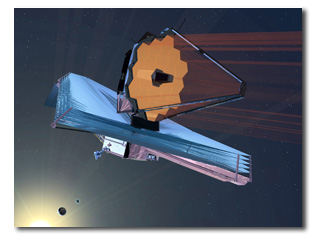
JAMES WEBB SPACE TELESCOPE
a.) It will observe primarily in the infrared light, but it can observe some visible light
c.) it can see light from 0.6 to 27 micrometers in wavelength
d.) it uses mirrors, optics, detectors, microshutters, and cryocooler.
Wednesday, September 24, 2008
Reflector vs. Refractor
1.) He used a mirror in his telescope and his telescope could see the color spectrum.
2.) His discoveries proved that not everything in the universe revolved around the Earth, and the Church believed the Bible said the Earth was the center of the universe.
3.) It proved that the Sun was the center of the universe. It discovered the moons of Jupiter. It discovered galaxies
2.) His discoveries proved that not everything in the universe revolved around the Earth, and the Church believed the Bible said the Earth was the center of the universe.
3.) It proved that the Sun was the center of the universe. It discovered the moons of Jupiter. It discovered galaxies
Monday, September 22, 2008
The Moons of Jupiter: Astro Lab 2
a) what patterns are observed, and what does that suggest?
The patterns of waves, and it suggests periods
b) why did Galileo see this as a 'mini-solar system'
He thought the moons of Jupiter were like planets, and they were circling Jupiter
c) what is so special about Io?
It has the closest wavelengths and it's the closest moon to Jupiter
d) how do your findings relate to Kepler's laws?
The moon's don't orbit in a perfectly circle orbit, but in a more oval-like orbit.
The patterns of waves, and it suggests periods
b) why did Galileo see this as a 'mini-solar system'
He thought the moons of Jupiter were like planets, and they were circling Jupiter
c) what is so special about Io?
It has the closest wavelengths and it's the closest moon to Jupiter
d) how do your findings relate to Kepler's laws?
The moon's don't orbit in a perfectly circle orbit, but in a more oval-like orbit.
Subscribe to:
Posts (Atom)